
String theory
1. From Points to Strings
General relativity describes gravity through a dynamical spacetime metric; quantum field theory describes fluctuating fields and their particles. Quantizing small metric fluctuations works as a low energy effective theory, but increasingly many higher derivative counterterms are needed at higher orders. Nonrenormalizability does not invalidate every low energy prediction: it limits extrapolation to arbitrarily short distances. String theory seeks a more complete microscopic description.
Its basic perturbative object is a one dimensional string, whose history sweeps out a two dimensional worldsheet. A particle sweeps out a worldline. Different quantum excitations have different masses and spins; a suitable closed string spectrum contains a massless spin 2 state with gravitational interactions. This motivates the theory but does not establish that nature has chosen it.
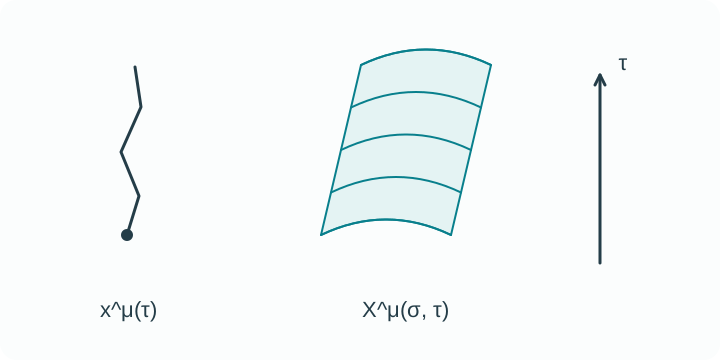
The worldsheet describes the string's history, not an extra pair of spacetime dimensions.
Use , string length and tension . Tension is energy per length, so has dimensions of length squared. The dimensionless coupling controls splitting, joining and the expansion in worldsheet topology; it is not the tension. A fundamental string is not an elastic wire made of atoms. Tong's lectures develop these starting points. 1
2. Classical Dynamics of Strings
Nambu–Goto Action
In flat spacetime with signature , specifies the string's position. The induced metric measures distances on its worldsheet:
The determinant converts a coordinate patch into physical area; its sign reflects a timelike surface. Extremizing the action gives a relativistic version of a minimal surface. It does not minimize the string's instantaneous spatial length.
Polyakov Action
An auxiliary metric makes the action quadratic in derivatives. Varying this independent metric gives the worldsheet stress tensor constraint:
For a nondegenerate surface the constraint makes proportional to . Substitution recovers Nambu–Goto. The proportionality remains free: under the local Weyl rescaling the area element and inverse metric cancel in two dimensions. Coordinate reparametrization and Weyl symmetry remove redundant descriptions. This is a classical equivalence; the quantum measure and anomalies need additional care. 2
3. Quantization and Mode Expansion
Locally choose conformal gauge while retaining the constraints. The flat target space equations become
This is a wave equation on the worldsheet, not a claim that spacetime is two dimensional. Global worldsheet moduli require separate treatment.
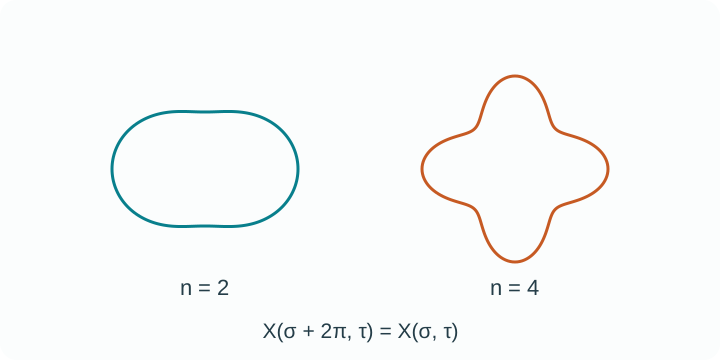
These are schematic wave profiles, not photographs of a quantum string.
Mode Expansion (closed string):
For a noncompact coordinate choose and periodic boundary conditions:
The first terms describe the centre of mass; the two oscillator families travel in opposite directions. Periodicity requires integer . A convention with period shifts factors of two between the zero mode and exponents without changing physics. Compact coordinates also admit winding.
Virasoro Constraints
The Fourier components of obey classically. Their quantum algebra has a central term. In covariant bosonic quantization physical states instead obey
with corresponding conditions for the tilde sector. One cannot set every quantum generator to zero as an operator. The matter and gauge fixing ghost contributions to the conformal anomaly must cancel: for a flat bosonic string , while the standard critical superstring has . Curved backgrounds must also have vanishing worldsheet beta functions. Classical Weyl symmetry alone does not establish a consistent quantum conformal field theory. 3 4
4. Mass Spectrum
For an uncompactified closed bosonic string, the two zero mode conditions give
is oscillator excitation energy: a mode is weighted by , rather than simply counting strings. At , signals instability of this bosonic vacuum; a tachyon is not a usable faster than light messenger. The level is massless, and gives . This toy calculation does not predict electron or proton masses. Superstring sectors have different intercepts and projections. 3
Special states:
At level the two transverse polarization indices decompose into a symmetric traceless tensor (graviton), an antisymmetric tensor ( field) and a scalar (dilaton). Open strings can supply massless vector bosons. Gauge bosons also arise in closed heterotic strings, so open strings are not the only route to gauge interactions.
Gravity is more than a spin label. To leading order in , with constant dilaton and vanishing field, quantum worldsheet consistency requires
The leading equation is the vacuum Einstein equation . Higher curvature corrections become important when the curvature radius approaches ; extra fields add terms. This is a controlled low energy relation, not proof that all singularities are resolved. 5
5. The Five Superstring Theories
The familiar five classify ten dimensional supersymmetric perturbative string theories, not every possible string background. Worldsheet fermions together with consistent projections produce tachyon free supersymmetric spectra; adding fermions alone does not guarantee this. Supersymmetry is a property of these constructions, not an observed symmetry of nature.
(1) Type I
Unoriented open and closed strings with 16 spacetime supercharges. Anomaly cancellation selects the conventional gauge algebra. Gauge degrees of freedom reside in the open sector; gravity is in the closed sector.
(2) Type IIA
Oriented closed strings with 32 supercharges of opposite spacetime chirality. The usual massless description contains the metric, dilaton, field and Ramond–Ramond potentials , whose field strengths have even degree.
(3) Type IIB
Oriented closed strings with 32 supercharges of the same chirality. Ramond–Ramond potentials have odd degree field strengths; the five form field strength is self dual. A potential's degree and its field strength's degree differ.
(4) Heterotic
A left moving bosonic sector and right moving supersymmetric sector share ten target spacetime coordinates. The additional left moving central charge comes from internal degrees of freedom, not sixteen extra macroscopic spatial dimensions. The conventional gauge name has the more precise global form .
(5) Heterotic
The alternative consistent gauge lattice gives , again with 16 supercharges. Compactification can produce chiral gauge theories, but this label does not uniquely fix observed particles or couplings. The theories also contain extended objects beyond perturbative strings: D-branes are dynamical objects on which open strings can end and which carry Ramond–Ramond charge in type II theory. 6 13
6. M-Theory and Dualities
A duality identifies observables in different descriptions, often turning a difficult problem into a tractable one. T-duality exchanges compact momentum and winding; S-duality relates certain weak and strong coupling regimes. Not every model has the simple symmetry .
Strongly coupled type IIA develops an eleven dimensional interpretation with . The circle grows with coupling; eleven dimensional supergravity is the low energy limit. Such relations motivate M-theory, but do not provide one universally applicable formulation on arbitrary backgrounds or an experimental discovery of an eleventh dimension. 6
Compactification: a circle you can calculate
Identify . A single valued wavefunction requires , hence with integer . A closed string may wrap the circle times. Tension times length gives the winding energy .
Here , counts the earlier oscillators and counts . The last equality fixes the level matching sign convention. Exchanging and leaves the spectrum invariant. At the unit momentum contribution is , while unit winding contributes ; at the dual radius they interchange. These are contributions to the mass formula, not necessarily a state's total mass. 7
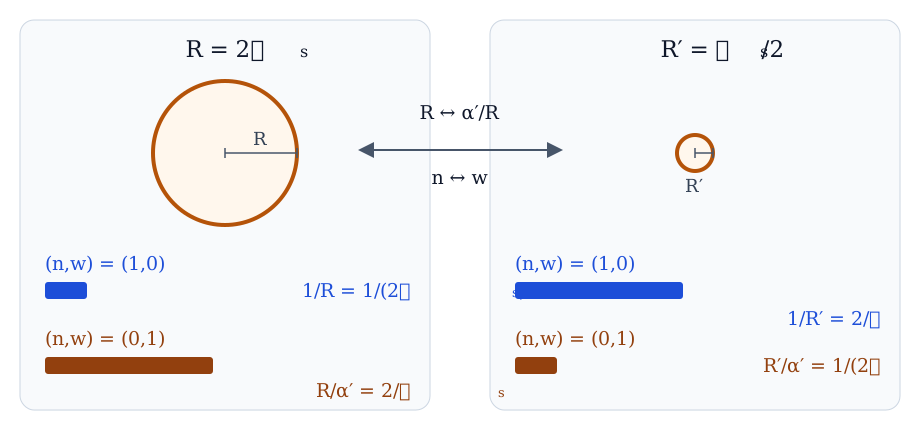
Blue: momentum contribution . Orange: winding contribution . The diagram illustrates a calculation, not observed extra dimensions.
In four dimensional model building, six compact spatial dimensions have geometry, fluxes and possibly branes. Their sizes and shapes become scalar fields called moduli. Stabilization matters: freely varying moduli could change couplings or mediate unobserved long range forces. “Too small to see” is not a complete compactification model.
7. AdS/CFT Correspondence
Maldacena's best studied example relates type IIB strings on to four dimensional supersymmetric Yang–Mills theory. AdS has negative cosmological constant. The boundary theory contains no dynamical gravity yet is proposed to encode the gravitational bulk. 8
The boundary value sources an operator ; source derivatives produce correlation functions. Under the correspondence, the boundary theory supplies a nonperturbative definition for this specified bulk setting. That is not a general proof of all proposed holographic dualities. 9
When geometry becomes a useful approximation
Let be the number of colors in the gauge theory and the AdS radius. In a common normalization,
Large 't Hooft coupling suppresses string length corrections; sufficiently large at fixed suppresses string loops. Classical supergravity needs both. Strongly coupled gauge physics can therefore correspond to weakly curved gravity; weak gauge coupling generally does not give the same simple geometry.
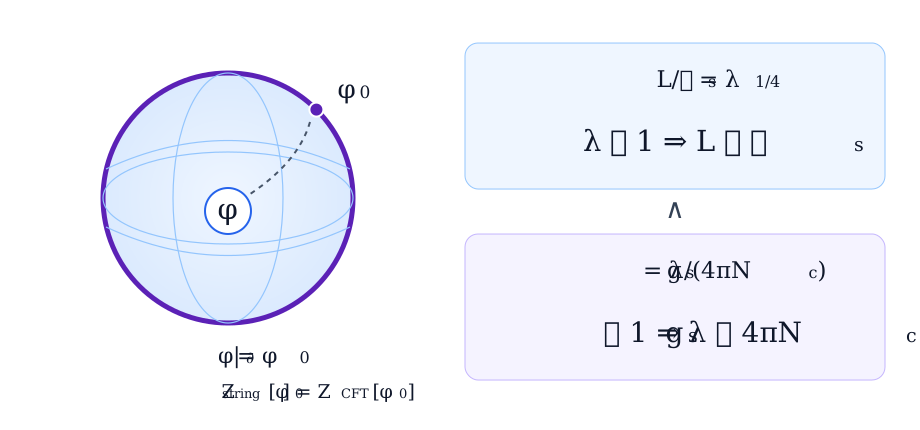
The disk is a schematic spatial slice. A boundary source and bulk field describe matched observables. and control different corrections; neither is experimental evidence.
8. Challenges and Open Questions
Three questions differ: Is a construction consistent? Does a duality relate two constructions? Does either describe our universe? Success on the first two does not settle the third. Our cosmology is not the exact AdS vacuum above, and that gauge theory is not the Standard Model.
The landscape comprises many candidate compactifications and vacua. Numbers such as are model dependent estimates, not an established count of all physical universes. Counting flux choices does not settle stability, cosmological selection or probabilities. Denef and Douglas make a specific counting problem and its assumptions explicit. 10
What the evidence does and does not show
Strominger and Vafa counted protected states for a special class of extremal supersymmetric five dimensional black holes, reproducing the leading Bekenstein–Hawking entropy. This connects quantum states to horizon area. It is not a direct count for an observed astrophysical black hole or a complete account of generic evaporation. 11
Cheung and collaborators, in work published in 2026, derive specific string scattering amplitudes under assumptions including tree level dynamics, ultrasoft high energy behavior and minimal residue zeros. This is a result about that amplitude class, not an assumption free derivation of our universe or experimental confirmation. 12
Tests need specified models: extra particles, compactification scales, cosmic strings and cosmological signatures require further choices. Macroscopic cosmic string defects are not automatically fundamental strings. Detecting supersymmetry or an extra dimension alone would not uniquely select this framework; excluding one accessible parameter range would not exclude all compactifications. The string scale is not universally fixed to the four dimensional Planck scale.
Status
Checked through 13 October 2026: string theory is a candidate quantum gravity framework with powerful calculations and duality evidence, but no established direct experimental confirmation that fundamental strings describe nature. Its mathematical achievements must be read with their assumptions, and its cosmological claims judged by observable predictions. The open task is to connect a controlled vacuum and cosmological history to distinctive, testable physics.